Crawford County, 6 February – no word on where he was born
Online family trees
“Darmstadt”
the state turned into a city
None of the five names a village – four give a state or a city that was not his home. That is where the research starts.
One form, no village
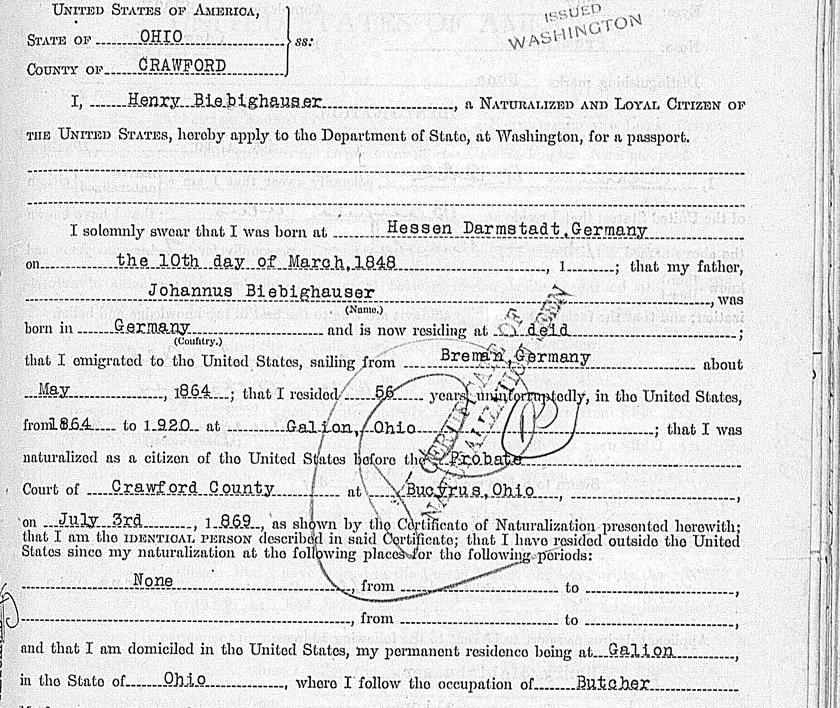
In May 1920, at seventy-two, Henry Biebighauser of Galion, Ohio, applied for a US passport to sail on the Lapland. The form gives his birth date, 10 March 1848, his father, Johannes, and his port, Bremen. For his birthplace it says only “Hessen Darmstadt, Germany”.
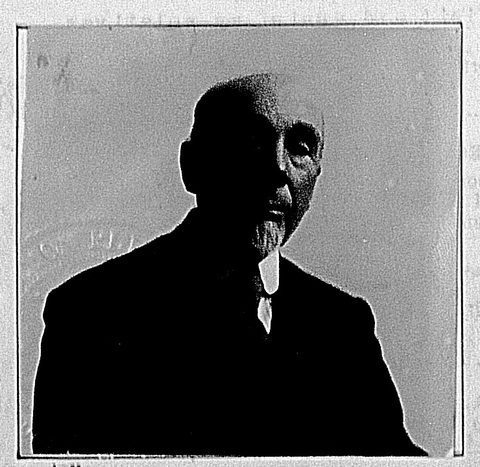
“I was born at Hessen Darmstadt, Germany, on the 10th day of March, 1848.” His passport application, May 1920 (detail). Click to see the whole page.1The applicant, aged 72.1
The 1870 census says “Hesse Darmstadt” too. Online trees turned the state into a city: born “Darmstadt”.
Three clues, one of them false
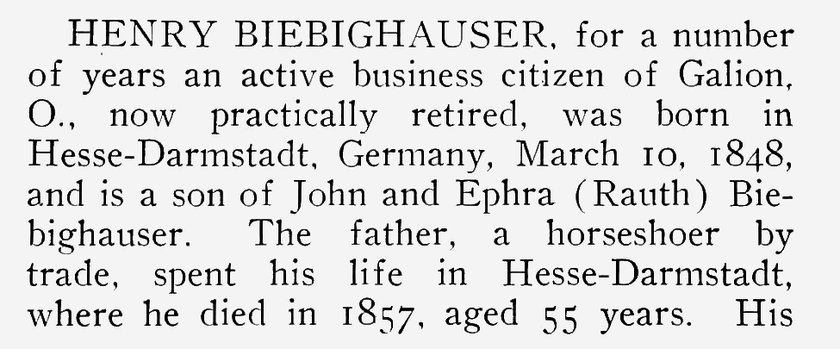
A county history of 1912 adds that his father was a horseshoer who died in 1857, aged 55, and names his mother “Ephra (Rauth)”. The surname itself looks like a place. And a village list from Dodenau names a Heinrich born on his birthday. Leads, not proof: we needed the register.
Passport application, 1920
“Hessen Darmstadt”
↓
In 1848 that meant
the Grand Duchy of Hesse – Dodenau lay in it
very likely · register entry
County history, 1912
“Ephra (Rauth)”
↓
Baptism register, 1848
Elisabetha (?) née Rauch
very likely maiden name · open first name
The surname
Biebighausen?
false lead
A hamlet of fourteen people today. Nearly all the Biebighäusers in online family trees were born in Dodenau and nearby villages.
A surname taken from a place is centuries older than the move.
The way home
From the upper Eder to Ohio – and back, three times
The red thread is the way he went: from Dodenau to Bremen in 1864 or 1866 – the two American sources disagree – and on to Ohio. The thin dotted lines are three later crossings back to New York (likely – reported, not yet checked in the original lists). Modern borders; state lines and sea lanes drawn roughly.
What a Village Check finds
The register answers
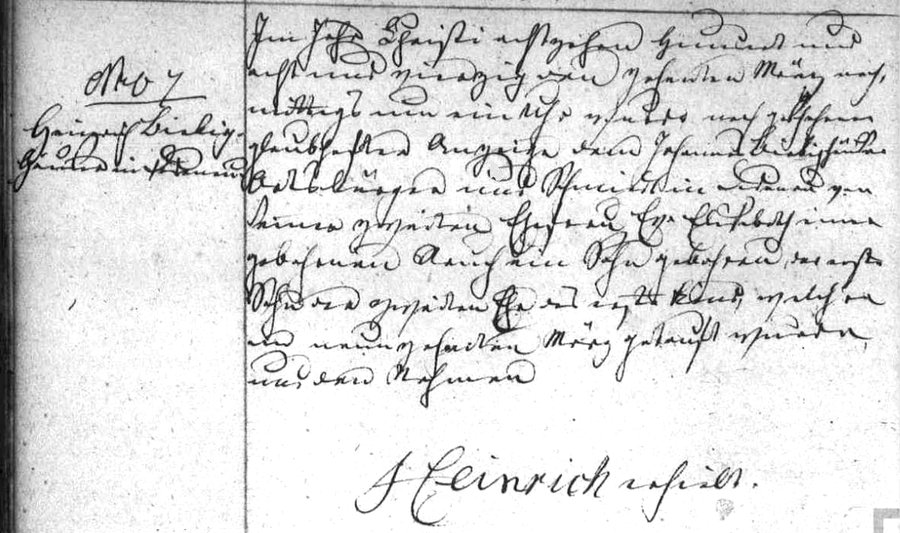
The Dodenau baptism register has, as No. 7 of 1848, a son born on 10 March and baptized on 19 March, named Heinrich – the first child of the second marriage of Johannes Biebighäuser. His mother: Elisabetha (?) née Rauch. Her first given name is not clear yet; “Ephra” may be how an American ear caught “Eva”.
née
French for “born”: the name a woman was born with. Elisabetha née Rauch was born a Rauch.
why a church book
German civil registers began only in 1874–1876. Before that, the parish books of baptisms, marriages and burials are the record of a life.
The original entry. Dodenau baptism register, 1848 No. 7: the number and his name in the margin, the text of the entry, and at the foot the name he was given, “Heinrich”.4
Our transcription of the same entry, set in a Kurrent hand
Im Jahr Christi achtzehnhundert und achtundvierzig den zehnten März nachmittags um ein Uhr wurde … dem Johannes Biebighäuser, Ortsbürger und [?], von seiner zweiten Ehefrau [?] Elisabetha geborenen Rauch ein Sohn geboren, das erste Kind der zweiten Ehe, welcher am neunzehnten März getauft wurde und den Namen Heinrich erhielt. – In the year of Christ 1848, on 10 March at one in the afternoon, … a son was born to Johannes Biebighäuser, citizen and [?], by his second wife [?] Elisabetha née Rauch – the first child of the second marriage – who was baptized on 19 March and received the name Heinrich.
Move the glass over the writing. Only words we are sure of are written out; “[?]” marks a word still open, “…” words left out.
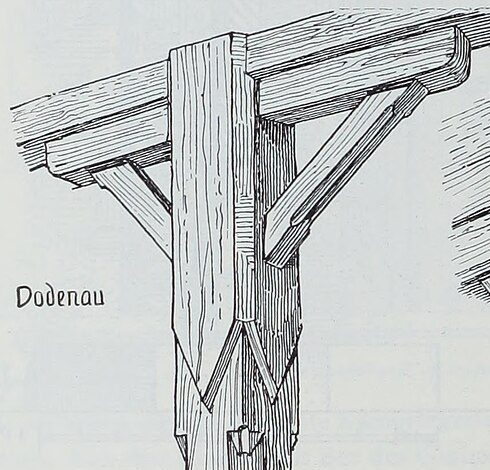
The church in Dodenau: a post of its gallery, drawn about 1910.5
Two more entries close the case. Johannes, a smith born on 3 June 1802, married a widow née Rauch in November 1847. He died on 28 December 1857, aged 55 years, 6 months and 25 days – exactly the time since 3 June 1802. Three American details now meet independent German entries: the birth date, the father, the mother’s maiden name. In 1848 Dodenau lay in the Grand Duchy of Hesse – “Hessen Darmstadt”. Today it is part of Battenberg (Eder).
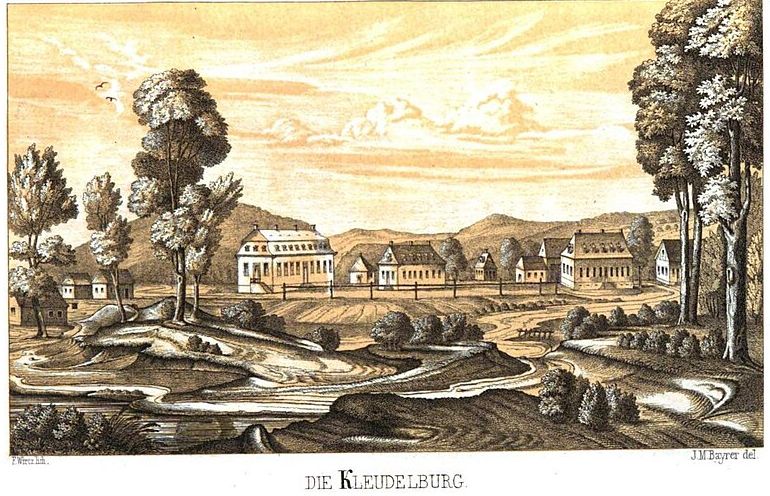
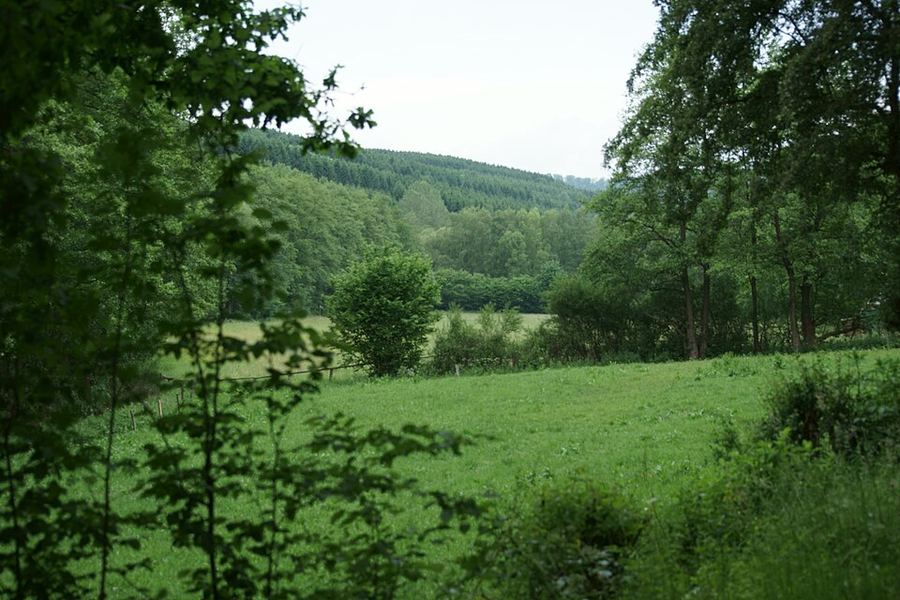
Then. The Kleudelburg, a hunting lodge north of Dodenau, after a picture of about 1850 – the years he grew up.6Now. The Riedgraben valley near Dodenau, 2017.7
His life on one sheet
1848 to 1921
In Dodenau
1848Born in Dodenau on 10 March, baptized on 19 March
1857His father Johannes, smith, dies aged 55 – Heinrich is nine
1864/66Sails from Bremen – “May 1864” on the passport, 1866 in the county history
In Ohio
1869Naturalized at Bucyrus, Ohio
1870Blacksmith, 22, in his brother August’s household in Galion – his father’s trade
1873Marriage license, Crawford County, 6 February
1909Back in New York from Bremen, August
1912County history: a butcher in Galion
1914Back from Rotterdam in October – the war had begun
1920At 72, applies for a passport to visit relatives in Europe
1921Back from Bremen, August
1921Dies in Galion on 14 November
Red: born and leaving. Small rings: later crossings back to Europe.
What Back Through the Generations adds
Back to 1692
The father’s line runs back six generations in the same parish. From 1717 to 1846 the entries place the family “auf der Hobe” – a house name that sets it apart from the other Biebighäusers in Dodenau.
1848Heinrich, later Henrybaptized in Dodenauvery likely
1721Johannes× Catharina Elisabethavon der Hobelikely
1717Christianmarries Anna Margaretha, “son of the late Volpert … auf der Hobe”likely
1692Volpertmarries Anna Catharina – no parents namedlikely
c. 1606Richard?buried 1669 – a family book’s guess, no record links himpossible
Years are baptisms, or marriages where no baptism was read. The line ends as proof at Volpert: the leaf that should hold his baptism in 1666 is torn and water-damaged, and his marriage names no parents.
Why we’re sure
What makes the answer hold – and what is still open
Three independent matches. His birth date, his father’s name and his mother’s maiden name in the American records meet three separate German entries.
The arithmetic agrees. 55 years, 6 months and 25 days from 3 June 1802 lands exactly on 28 December 1857 – the day of his death in the burial entry.
A copy is not a confirmation. The village’s own emigrant list agrees – but its American half seems to come from the same county history, so we counted it once.
A trap avoided. The bride of 1847 was herself the widow of another Biebighäuser. Her birth date and her father’s name keep the two women apart.
Still open: the mother’s first given name (perhaps Eva) and the year he left, 1864 or 1866. A client search would also rule out another boy of the same name born in the parish in those years.
Tell us what your family knows. The free brick-wall check takes a few minutes; the free case review comes within 3 working days – an honest view of your chances, what we would do first, and a fixed price.