| Prussia and its provinces |
|---|
| PrussiaPreussen, Preußen, Prussen, Prusia |
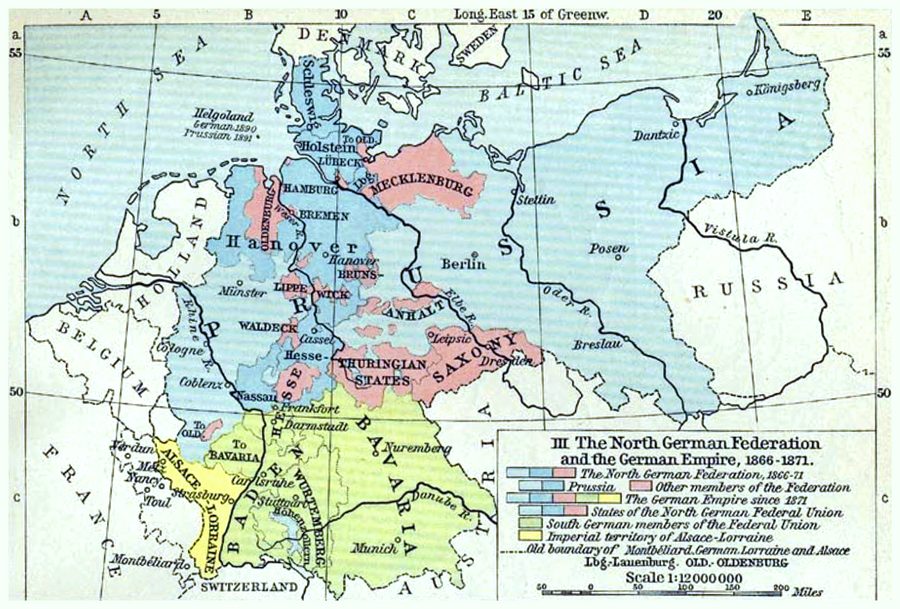
Kingdom 1701–1918, then a German state until it was abolished in 1947. From 1815 it reached from the Rhine to beyond the Vistula; in 1866 it annexed Hanover, Hesse-Cassel, Nassau, Frankfurt and Schleswig-Holstein. |
Germany: all or part of most of today’s states. Also Poland, Russia (Kaliningrad region), Lithuania, and small areas of Denmark, Belgium and the Czech Republic. |
Prussia covered almost two-thirds of the German Empire – the province (rows below) narrows it down. |
| East PrussiaOstpreussen, Ost-Preußen, E. Prussia |
Prussian province from 1773 to 1945 (joined with West Prussia as the “Province of Prussia” 1829–1878). Capital Königsberg. |
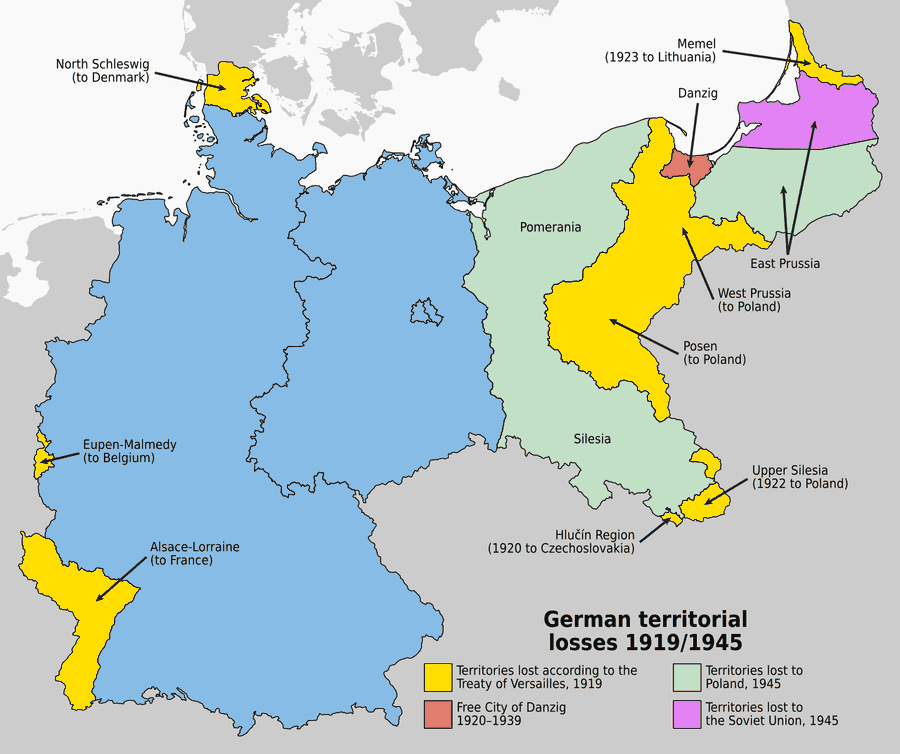
South: Poland. North: Russia (Kaliningrad region; Königsberg is Kaliningrad). The Memel area: Lithuania (Klaipėda). |
Many church books were lost in 1945; what survives is spread over several countries. Places now have Polish, Russian or Lithuanian names. |
| West PrussiaWestpreussen, W. Prussia |
Prussian province 1773–1829 and 1878–1920. Danzig, Marienwerder, Thorn. |
Poland (Danzig is Gdańsk; a Free City 1920–1939). |
Most of it was Polish from 1920, the rest from 1945 – look for the village under its Polish name. |
| PosenProvince or Grand Duchy of Posen, Prussian Poland, Posnania |
Prussian from 1793 (except 1807–1815); then the Grand Duchy, later Province, of Posen until 1920. |
Poland (Posen is Poznań). |
Mostly Polish from 1920, the western edge from 1945; records largely in Polish archives. One person may appear as Prussian, German or Polish. |
| SilesiaSchlesien, Silesien, Prussian Silesia |
Prussian from 1742; one province from 1815, split into Lower and Upper Silesia in 1919. Breslau, Liegnitz, Oppeln. |
Almost all Poland (Breslau is Wrocław). West of the Neisse around Görlitz: Germany (Saxony). The Hlučín area: Czech Republic. |
Eastern Upper Silesia became Polish in 1922, nearly all the rest in 1945. “Austrian Silesia” (Troppau, Teschen) is a different land – today Czech Republic and Poland. |
| PomeraniaPommern, Pomern |
Prussian province 1815–1945; Stettin, Köslin, Stralsund. |
West of the Oder: Germany (Mecklenburg-Western Pomerania). Stettin and everything east: Poland (Stettin is Szczecin). |
Two countries: for the eastern part, records are partly in Polish archives. |
| BrandenburgMark Brandenburg |
The core of Prussia; province 1815–1945, around Berlin. |
Brandenburg and Berlin. The Neumark east of the Oder: Poland. |
East of the Oder, look for the Polish place name. |
| Province of SaxonyPrussian Saxony, “Saxony, Prussia,” Provinz Sachsen |
Prussian province 1816–1944, made largely of land Saxony lost in 1815. Magdeburg, Halle, Erfurt. |
Mostly Saxony-Anhalt; the Erfurt area: Thuringia. |
Not the Kingdom of Saxony. “Saxony” together with “Prussia” points here. |
| WestphaliaWestfalen, Westphalen, Westfalia |
Prussian province 1815–1946. Münster, Minden, Arnsberg. |
North Rhine-Westphalia. |
For a birth in 1807–1813, “Westphalia” may mean Napoleon’s Kingdom of Westphalia – a different area, around Kassel and Brunswick. |
| Rhine ProvinceRhenish Prussia, Rhineprussia, Rheinpreussen, Rheinprovinz, Rhineland |
Prussian from 1815; one province 1822–1946. Cologne, Düsseldorf, Aachen, Koblenz, Trier. |
North Rhine-Westphalia (north), Rhineland-Palatinate (south), most of Saarland. Eupen-Malmedy: Belgium since 1920. |
West of the Rhine, civil registers begin about 1798, under French rule – often written in French. |
| HohenzollernHohenzollern-Sigmaringen, Hohenzollern-Hechingen |
Two small principalities; Prussian from 1850 (the “Hohenzollern Lands”). Sigmaringen, Hechingen. |
Baden-Württemberg. |
A record may say “Prussia” for a village in Swabia, between Württemberg and Baden. |
| Annexed by Prussia in 1866 |
|---|
| HanoverHannover, Hanovre, Hanoverian, Kingdom of Hanover |
Electorate, then kingdom 1814–1866 (its king was the British king until 1837). Annexed by Prussia in 1866; Prussian province until 1946. |
Lower Saxony. |
The same village is “Hanover” before 1866 and “Prussia” after. |
| Hesse-CasselHessen-Kassel, Hesse Cassel, Kurhessen, Electoral Hesse |
Landgraviate; an electorate from 1803 (under Napoleon 1806–1813) until 1866. Annexed by Prussia in 1866, then part of the province of Hesse-Nassau. Kassel, Marburg, Fulda, Hanau. |
Hesse; small parts in Lower Saxony (Rinteln) and Thuringia (Schmalkalden). |
After 1866 the same village is “Prussia” or “Hesse-Nassau” on later papers. |
| NassauDuchy of Nassau, Herzogtum Nassau |
Duchy 1806–1866; annexed by Prussia in 1866, then part of Hesse-Nassau. Wiesbaden, Limburg, Dillenburg. |
Hesse; the western part (Montabaur, Diez, the Westerwald): Rhineland-Palatinate. |
Two states today – the village decides which. |
| Hesse-NassauHessen-Nassau |
Prussian province 1868–1944: Hesse-Cassel, Nassau, the city of Frankfurt (a free city until 1866) and a strip of Hesse-Darmstadt. |
Mostly Hesse; the western edge: Rhineland-Palatinate. |
A post-1866 name: someone born earlier was born in one of the older states. |
| Schleswig, HolsteinSchleswig-Holstein, Sleswick, Holstein-Denmark |
Duchies ruled by the Danish king until 1864; Prussian after the wars of 1864 and 1866. Kiel, Altona, Flensburg. |
Schleswig-Holstein; North Schleswig: Denmark since the 1920 vote. |
Before 1864, US records may say “Denmark” for a German-speaking village. |
| The southwest and south |
|---|
| Hesse-DarmstadtHessen-Darmstadt, Grand Duchy of Hesse, Hesse Darmstadt |
Landgraviate; Grand Duchy of Hesse 1806–1918, then the People’s State of Hesse. Darmstadt, Giessen, Mainz, Worms. |
Hesse; Rhenish Hesse (Mainz, Worms, Alzey): Rhineland-Palatinate. |
Its northern tip around Biedenkopf became Prussian in 1866. Our guide to Hesse-Darmstadt. |
| HesseHessen, Hessia, Hessian |
Not one state before 1866: Hesse-Darmstadt, Hesse-Cassel and Nassau lay side by side. |
Hesse or Rhineland-Palatinate. |
Find out which Hesse first – some Americans said “Hessen-Darmstadt” for any part of it. |
| WürttembergWurtemberg, Würtemberg, Wuertemberg, Wurttemberg, Wirtemberg |
Duchy; kingdom 1806–1918, then a free state. Stuttgart, Ulm, Tübingen, Heilbronn. |
Baden-Württemberg (formed 1952). |
Württembergers called themselves Swabians – “Swabia” on a record may mean Württemberg. |
| BadenBaaden, Grand Duchy of Baden |
Margraviate; grand duchy 1806–1918, then a republic. Karlsruhe, Mannheim, Heidelberg, Freiburg, Konstanz. |
Baden-Württemberg (formed 1952). |
A long, narrow land along the Rhine, from Lake Constance to north of Heidelberg. |
| BavariaBayern, Baiern (older spelling), Bavarian |
Electorate; kingdom 1806–1918, then a free state. Gained Franconia and Bavarian Swabia in the Napoleonic years; held the Palatinate west of the Rhine 1816–1945. Munich, Augsburg, Nuremberg, Würzburg. |
Bavaria; the Palatinate: Rhineland-Palatinate (Homburg and St. Ingbert area: Saarland). |
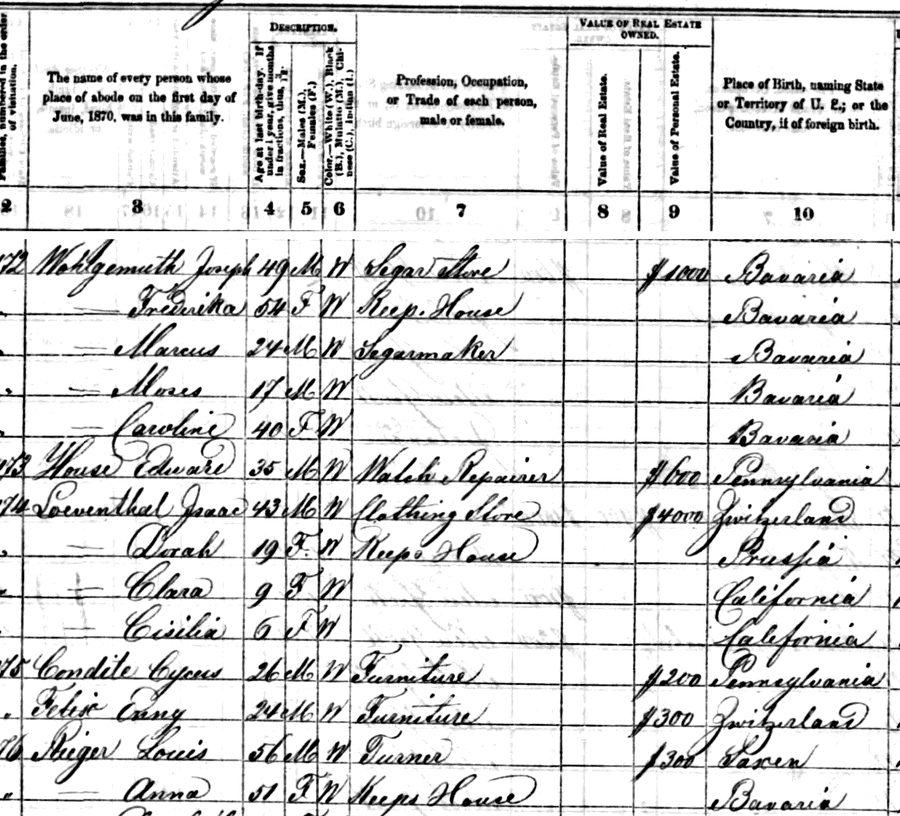
“Bavaria” on a US record can mean the Palatinate on the Rhine, far from Munich. |
| PalatinatePfalz, Rheinpfalz, Rhenish Bavaria, Rhine Bavaria, Rheinbayern, Bavarian Palatinate, Palatine |
Before the 1790s divided among the Electoral Palatinate and many small lands; French 1797–1814; Bavarian 1816–1945. Speyer, Kaiserslautern, Zweibrücken, Landau. |
Rhineland-Palatinate; the Homburg and St. Ingbert area: Saarland. |
The Palatinate belonged to Bavaria 1816–1945. Heidelberg and Mannheim (the old Palatinate east of the Rhine) are Baden; the Upper Palatinate is in eastern Bavaria. |
| FranconiaFranken |
A region, not a state; mostly Bavarian since the Napoleonic years. |
Northern Bavaria; edges in Baden-Württemberg and Thuringia. |
Upper, Middle or Lower Franconia – Bavaria’s districts – narrows it. |
| SwabiaSchwaben, Suabia |
A region, not a state: Württemberg, Hohenzollern, and Bavarian Swabia around Augsburg. |
Baden-Württemberg, or Bavaria (Bavarian Swabia). |
Two directions: the Stuttgart side or the Augsburg side. |
| Alsace-LorraineElsass-Lothringen, Alsace, Elsass, Lorraine |
French until 1871; the German “Reichsland” 1871–1918; French again from 1918. Strasbourg, Colmar, Mulhouse, Metz. |
France (Bas-Rhin, Haut-Rhin, Moselle). |
German only 1871–1918: born earlier or later means France. “Lorraine” alone may mean the part that was never German. |
| LuxembourgLuxemburg |
Grand duchy; member of the German Confederation 1815–1866. |
Luxembourg. |
Luxembourgers are sometimes recorded as German. |
| The north and center |
|---|
| SaxonySachsen, Saxe, Saxon, Kingdom of Saxony |
Electorate; kingdom 1806–1918, then a free state. Lost more than half its land to Prussia in 1815. Dresden, Leipzig, Chemnitz. |
Saxony. |
Not Prussian Saxony (Magdeburg, Halle) and not the “Saxe-” duchies of Thuringia. |
| Saxe-Weimar, Saxe-Coburg, Saxe-Meiningen, Saxe-Altenburg, Schwarzburg, ReussSachsen-Weimar, Sachsen-Coburg-Gotha, Thuringia, Thüringen |
Small grand duchy, duchies and principalities, each with its own records, until 1918. |
Thuringia (formed 1920); Coburg chose Bavaria in 1920. |
“Thuringia” was a region, not a state, before 1920 – the duchy’s name narrows it. |
| AnhaltAnhalt-Dessau, Anhalt-Köthen, Anhalt-Bernburg |
Small duchies, united as one Duchy of Anhalt in 1863; a free state from 1918. Dessau, Köthen, Bernburg, Zerbst. |
Saxony-Anhalt. |
A small land surrounded by Prussian territory – not the same as Prussian Saxony. |
| BrunswickBraunschweig, Duchy of Brunswick |
Duchy until 1918, then a free state until 1946. Brunswick, Wolfenbüttel, Helmstedt. |
Lower Saxony (small eastern parts: Saxony-Anhalt). |
Not “Brunswick-Lüneburg,” the old formal name of Hanover. |
| OldenburgGrand Duchy of Oldenburg |
Duchy, then grand duchy until 1918, a free state until 1946. Also ruled the Principality of Lübeck (Eutin) and Birkenfeld. |
Lower Saxony; Eutin area: Schleswig-Holstein; Birkenfeld: Rhineland-Palatinate. |
An “Oldenburg” ancestor may come from the Hunsrück: Birkenfeld was Oldenburg’s until 1937. |
| MecklenburgMecklenburg-Schwerin, Mecklenburg-Strelitz, Mecklenburgh |
Two grand duchies 1815–1918, then free states; merged in 1934. |
Mecklenburg-Western Pomerania. |
Two separate states: Schwerin (the larger) or Strelitz. |
| Lippe, Schaumburg-LippeLippe-Detmold, Bückeburg |
Two principalities until 1918, then free states. Detmold; Bückeburg. |
Lippe: North Rhine-Westphalia (1947). Schaumburg-Lippe: Lower Saxony (1946). |
Two different states – check which Lippe. |
| WaldeckWaldeck-Pyrmont |
Principality until 1918, then a free state; Pyrmont joined Prussia in 1922, Waldeck in 1929. Arolsen, Korbach. |
Hesse; Bad Pyrmont: Lower Saxony. |
A small land beside Hesse-Cassel – easily mistaken for “Hesse.” |
| Hamburg, Bremen, Lübeck |
Free cities. Lübeck became part of Prussia in 1937. |
Hamburg and Bremen are still states; Lübeck: Schleswig-Holstein. |
On a passenger list, Bremen or Hamburg is often only the port of departure, not the home. |
| The whole country |
|---|
| GermanyDeutschland, German Empire, Deutsches Reich |
Before 1871 a language and culture area of many states, not a country. The German Empire from 18 January 1871: a federation of the states above. |
Germany – or, for the lost eastern provinces and Alsace-Lorraine, Poland, Russia, Lithuania or France. |
Says nothing about the region; other papers must narrow it. |